


CBD
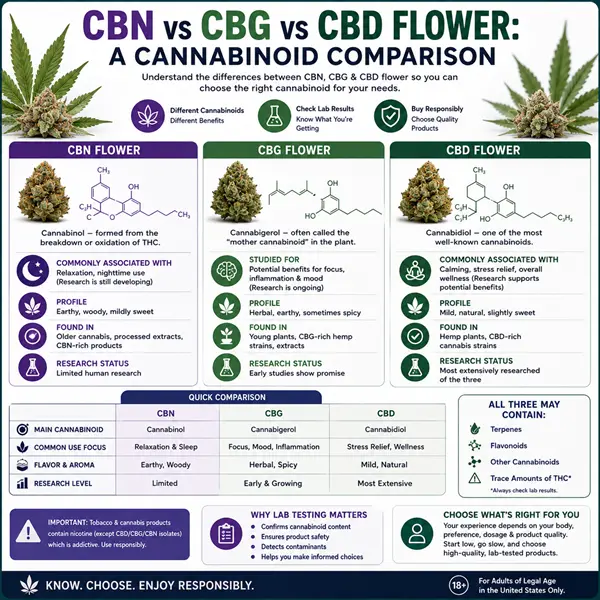
CBN vs CBG vs CBD Flower: A Cannabinoid Comparison
Sep
Cannabinoid terminology can get confusing quickly. Products may be described as CBD, CBG, CBN, hemp flower, or combinations of several cannabinoids, even though these compounds have different chemical profiles and may interact with the body differently.
For consumers researching CBD flower in the United States, understanding these distinctions is useful before comparing products. CBD, CBG, and CBN are all cannabinoids found naturally in cannabis plants, but they are not interchangeable.
The biggest difference is their cannabinoid profile. CBD flower generally refers to hemp flower that contains cannabidiol (CBD), while CBG and CBN describe products or flower varieties where cannabigerol or cannabinol is emphasized.
This guide compares the three and explains what consumers should know about cannabinoid content, product labeling, research, and responsible use.
What Is CBD Flower?
CBD flower generally refers to hemp flower cultivated to contain relatively high levels of cannabidiol (CBD) while remaining within applicable federal and state requirements for hemp-derived products.
Unlike CBD oils, capsules, or edibles, flower is an unprocessed or minimally processed plant material.
Depending on the cultivar, CBD flower can contain a range of naturally occurring compounds, including:
- CBD
- Small amounts of other cannabinoids
- Terpenes
- Flavonoids
- Other naturally occurring plant compounds
The exact cannabinoid profile varies between cultivars and products.
Importantly, consumers should not assume that CBD flower contains only CBD. Some hemp flowers can contain measurable THC, which makes checking laboratory results and product labeling important.
What Is CBG?
CBG stands for cannabigerol.
It is a naturally occurring cannabinoid found in cannabis and hemp plants. CBG is sometimes described as a “minor cannabinoid” because it is generally present in lower concentrations than CBD or THC in many conventional cultivars.
However, breeders have developed hemp varieties specifically selected for higher CBG concentrations.
CBG-focused products may therefore include:
- CBG flower
- CBG oils
- CBG extracts
- CBG-infused products
Research into CBG is ongoing. Although early scientific studies have investigated its biological properties, consumers should be cautious about treating preliminary research as proof of specific health benefits.
What Is CBN?
CBN stands for cannabinol.
Unlike CBD and CBG, CBN can form through the degradation or oxidation of THC over time. It can also occur naturally in cannabis material.
CBN products are commonly marketed around relaxation or nighttime use, but marketing claims should be considered carefully.
Research into CBN is still developing, and evidence does not justify assuming that a CBN product will produce a particular effect for every individual.
As with other cannabinoids, product composition and concentration matter.
CBN vs CBG vs CBD: What’s the Difference?
The simplest distinction is the cannabinoid being emphasized.
CBD: Cannabidiol
CBG: Cannabigerol
CBN: Cannabinol
All three are chemically related cannabinoids, but their molecular structures differ.
They also interact with the body’s endocannabinoid system in different ways, and researchers continue to investigate their potential biological effects.
Cannabinoid comparison at a glance
A simple educational comparison of the three cannabinoids discussed in this guide. This is not a potency or effectiveness ranking.
01234CBDCBGCBN
The chart is illustrative and does not represent cannabinoid potency, effectiveness, or recommended dosage.
CBD Flower vs CBG Flower
The distinction between CBD flower and CBG flower primarily comes down to the dominant cannabinoid.
CBD-dominant flowers are cultivated to produce higher CBD levels, while CBG-dominant flowers are specifically cultivated to produce more CBG.
Both can contain other cannabinoids and terpenes.
When comparing the two, don’t judge the product solely by its name. Instead, look at the laboratory-tested cannabinoid profile.
A certificate of analysis (COA) can help consumers determine:
- CBD concentration
- CBG concentration
- THC concentration
- Other tested cannabinoids
- Batch information
This is more informative than relying exclusively on product descriptions.
CBD Flower vs CBN Products
CBN is somewhat different from CBD and CBG because naturally occurring CBN concentrations can be relatively low in many cannabis varieties.
As a result, CBN-focused products may be formulated or processed specifically to contain higher levels of CBN.
When comparing CBN products with CBD flower, consumers should check whether they’re comparing like-for-like products.
For example, raw hemp flower and a concentrated cannabinoid extract aren’t equivalent simply because both contain cannabinoids.
Product format, concentration, ingredients, and testing all matter.
Does CBN Make You Sleepy?
CBN is frequently associated with nighttime or sleep-related products.
However, marketing claims can sometimes go further than the available scientific evidence.
Research into CBN and sleep is still developing, and consumers shouldn’t assume that taking CBN will automatically cause drowsiness or improve sleep.
Sleep difficulties can have many causes. Persistent sleep problems are better addressed with a healthcare professional rather than relying solely on cannabinoid products.
What About CBG and Energy?
CBG products are sometimes marketed as providing a more alert or focused experience.
These claims are not established as universal effects.
Individual responses can vary, and research into CBG’s effects in humans remains limited compared with more extensively studied cannabinoids.
Consumers should distinguish between anecdotal reports, marketing language, and established clinical evidence.
What Does CBD Do?
CBD has received considerable scientific attention.
Unlike THC, CBD is not generally considered intoxicating. However, that doesn’t mean it is completely risk-free.
CBD can interact with certain medications and may cause side effects in some people.
For anyone taking prescription medication, pregnant or breastfeeding, or managing a medical condition, discussing CBD use with a qualified healthcare professional is advisable.
How Terpenes Fit Into the Comparison
Cannabinoids aren’t the only compounds found in hemp flower.
Terpenes are aromatic plant compounds that contribute to the smell and flavor of different cultivars.
A flower’s overall chemical profile can therefore include:
- Cannabinoids
- Terpenes
- Flavonoids
- Other plant compounds
This is one reason two products with similar CBD concentrations may still have different characteristics.
However, claims about specific cannabinoid-terpene combinations producing predictable effects should be treated cautiously because research is still developing.
How to Read a Cannabinoid Product Label
If you’re researching CBD flower or other hemp-derived cannabinoid products, the label deserves close attention.
Look for:
Cannabinoid Concentration
Check the amount or percentage of CBD, CBG, CBN, and THC where provided.
Product Weight
Concentration and total product weight are separate measurements.
Laboratory Testing
A recent COA can provide additional information about the product’s tested cannabinoid profile.
Ingredients
Check whether the product contains only hemp flower or additional ingredients.
Batch Information
The testing document should correspond to the relevant product batch where possible.
Applicable Warnings
Follow the manufacturer’s safety and storage information.
Why Third-Party Testing Matters
Cannabinoid concentrations can vary, and labeling isn’t always enough to establish exactly what a product contains.
Independent laboratory testing can provide a more detailed picture.
A useful COA may test for:
- Cannabinoids
- THC
- Contaminants
- Heavy metals
- Pesticides
- Microbial contamination
Testing requirements can vary by jurisdiction and product category, so consumers should also check applicable state rules.
Are CBD, CBG, and CBN legal in the US?
The legal status of hemp-derived cannabinoid products in the United States can be complicated.
Federal rules, state laws, product composition, and regulatory developments can all matter.
A product’s legality shouldn’t be assumed simply because it is described as “hemp-derived.”
Consumers should check current federal and state requirements applicable to their location.
This is especially important because state rules can differ significantly.
Choosing Between CBD, CBG, and CBN
There isn’t a universally “best” cannabinoid.
The appropriate comparison depends on what you’re researching and the product’s actual composition.
Before making a decision, consider:
- Which cannabinoid is present?
- How concentrated is it?
- What other cannabinoids are included?
- Does the product contain THC?
- Is independent testing available?
- What does the applicable law allow?
- Are there medication or health considerations?
This approach is more reliable than choosing a product based solely on claims about a particular cannabinoid.
Conclusion
CBN, CBG, and CBD are distinct cannabinoids, even though they can all be found in hemp and cannabis plants.
CBD flower is generally associated with CBD-dominant hemp flower, while CBG products emphasize cannabigerol, and CBN products emphasize cannabinol. Their chemical profiles, concentrations, research evidence, and product formats can differ substantially.
For US consumers, the most useful comparison starts with the label and laboratory testing rather than marketing claims. Checking cannabinoid concentrations, THC content, ingredients, batch information, and applicable laws can help provide a clearer picture of what a product actually contains.
Research into minor cannabinoids such as CBG and CBN is continuing, so claims about specific effects should be viewed in the context of the available scientific evidence.
Frequently Asked Questions
1. Is CBD flower the same as CBG flower?
No. CBD flower generally refers to a flower with CBD as the dominant cannabinoid, while CBG flower is cultivated to contain higher levels of CBG. Both can contain additional cannabinoids and terpenes.
2. What is the difference between CBD, CBG, and CBN?
CBD stands for cannabidiol, CBG stands for cannabigerol, and CBN stands for cannabinol. They are different cannabinoids with different chemical structures and biological properties.
3. Is CBN stronger than CBD?
There isn’t a simple “stronger” comparison. CBN and CBD are different compounds, and their effects cannot be ranked universally by strength.
4. Is CBG intoxicating?
CBG is not generally considered intoxicating in the same way THC is. However, cannabinoid products can contain multiple compounds, so checking the complete product profile is important.